


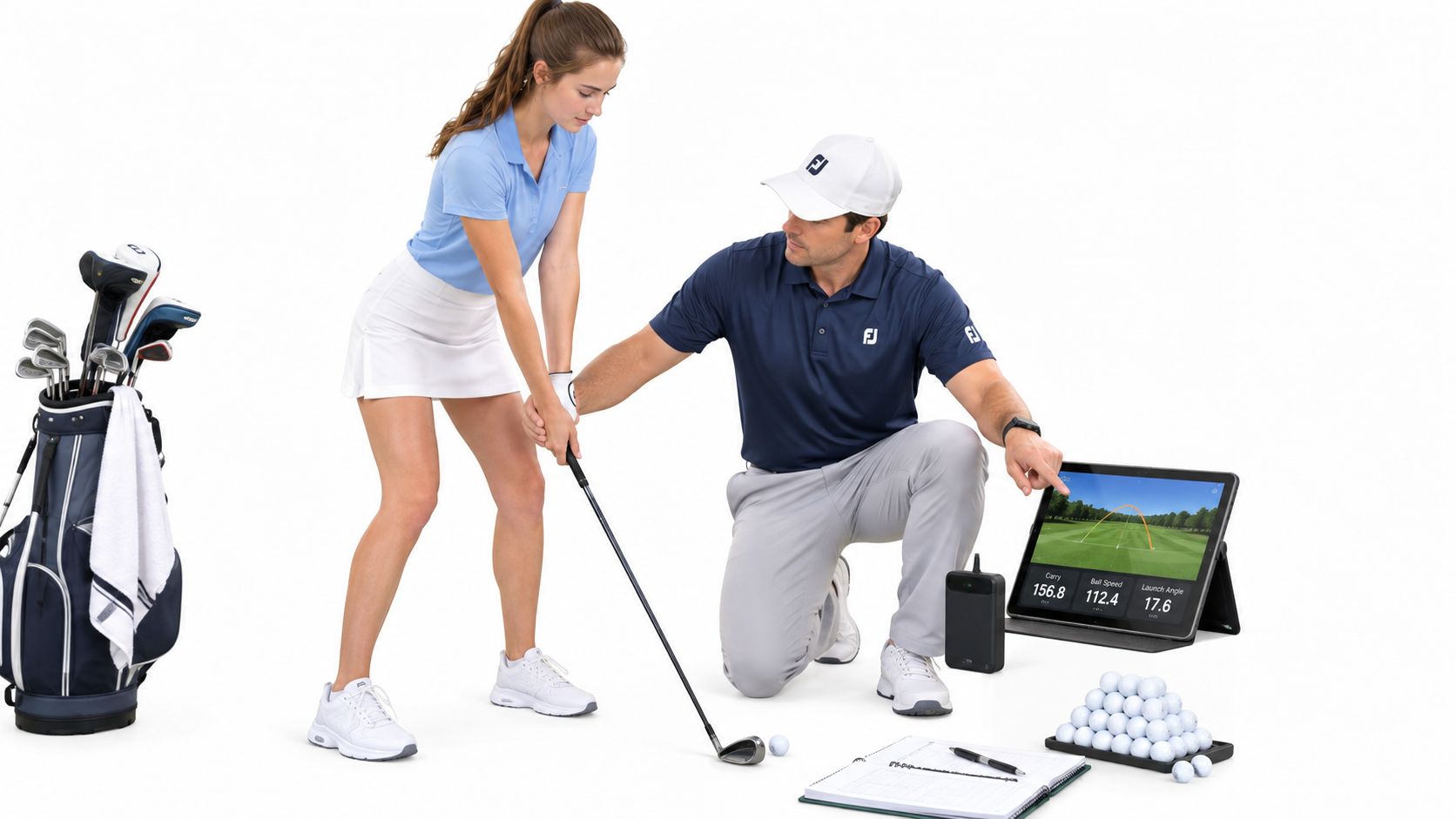
On this page
A professional golf lesson is a structured diagnosis of your ball flight and swing faults, usually lasting 30 minutes to 2 hours, with the aim of producing one measurable improvement rather than rebuilding your entire swing. It's less about collecting tips and more about finding the cause of the shot you're hitting, then testing a practical change.
You may be considering a lesson after another round of weak slices, topped irons or inconsistent putting. Perhaps you're buying for someone who plays regularly, but you don't know their handicap, preferred course or technical weakness. Either way, the useful question isn't just, “What happens during a lesson?” It's, “How will the coach identify what needs changing, and how will we know the change worked?”
The Typical Structure of a PGA Lesson
You arrive with a recurring problem, perhaps a weak slice, poor contact or unreliable wedge distance. The professional begins by clarifying the outcome you want and asking about the shots that cause trouble. A beginner may prioritise consistent contact, while an experienced golfer may want tighter dispersion or better preparation for a particular course.
The first swings provide a baseline. The coach watches your normal shot and records details such as start direction, curvature, strike location, carry distance and dispersion. These observations create a clearer starting point than deciding that a swing "looks wrong" on sight alone. PGA coaching guidance places ball flight and impact factors at the centre of diagnosis, then considers relevant movement limitations when they may explain the result. The approach is outlined in Open University research on golf needs analysis.
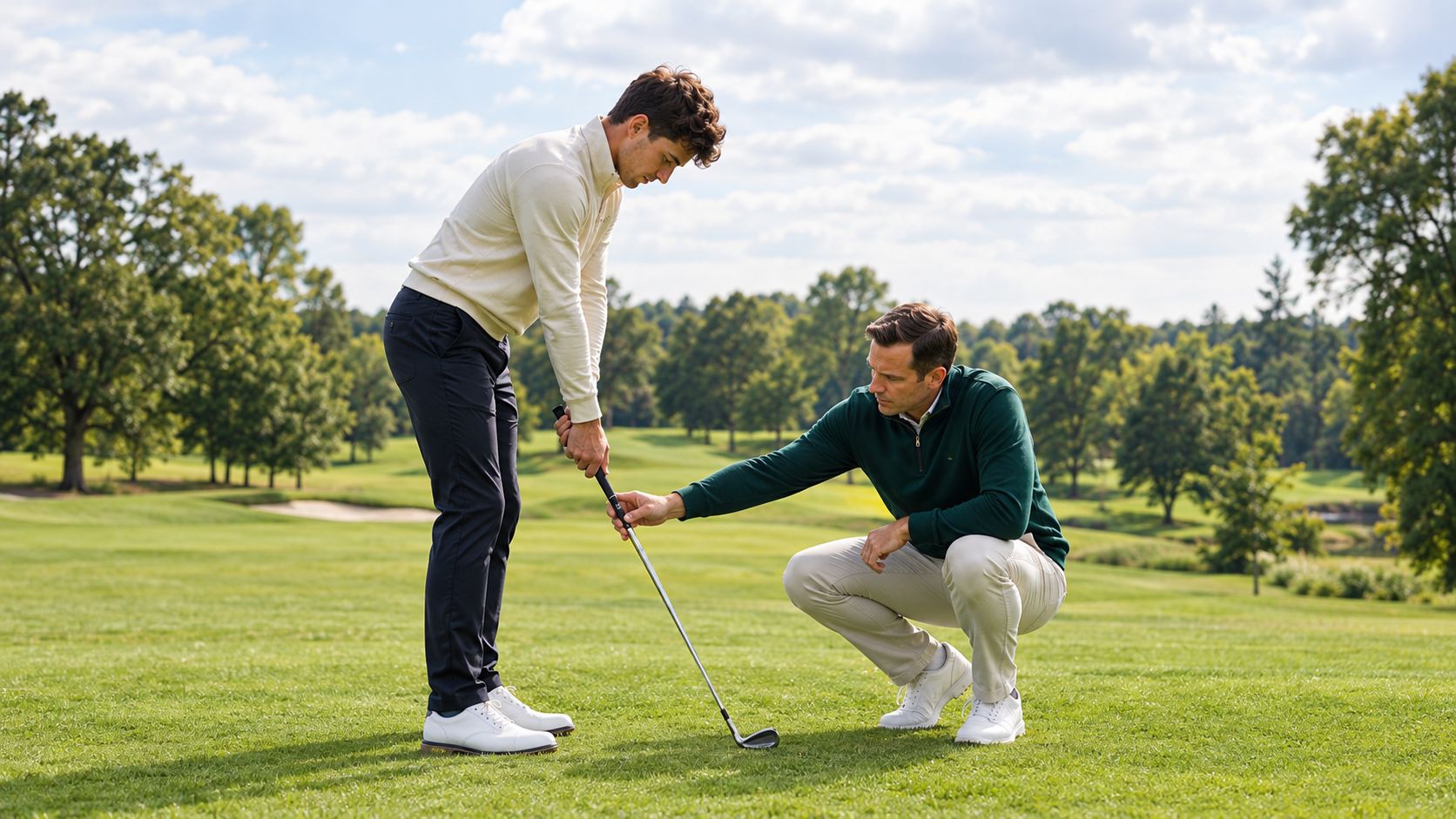
A session follows a cause-and-effect sequence
Suppose an iron starts left and curves farther left. Rather than immediately changing your backswing or finish, the coach examines what the club and ball are doing at impact. That evidence helps identify whether alignment, face control, delivery or another factor deserves testing.
The professional then changes one variable and asks you to repeat the shot. If the ball flight moves in the expected direction, the response supports that explanation. If it does not, the coach has learned that the first diagnosis needs adjustment. The lesson becomes a practical investigation, with each shot providing information for the next decision.
A useful lesson should leave you knowing what to practise, why it matters and what result to look for.
The closing stage converts the discovery into manageable practice. You might rehearse a movement without a ball, hit towards an external target or monitor whether contact and dispersion improve. A PGA Golf Lesson can be arranged as a one-to-one session from 30 minutes to multi-lesson packs, delivered by email and valid for 12 months, according to the listed experience details. The PGA Golf Lesson image shows the type of coaching experience such a voucher can represent.
The Modern Coaching Methodology Behind PGA Lessons
A golfer arrives with an iron that starts left and curves farther left. The professional does not begin by prescribing a new backswing position. The coach first examines the ball flight, strike and delivery, then tests which impact factor could be producing that pattern.
This order matters because a swing can look more conventional while the strike, face control or launch conditions remain unchanged. Movement analysis comes later, when it can explain the delivery or show why a player cannot make the required movement comfortably.
Why movement screening supports, rather than replaces, ball-flight diagnosis
A limited range of motion does not prove a specific swing fault. It becomes useful when the limitation plausibly relates to the observed delivery or makes a needed movement difficult to perform without discomfort. The screen therefore works like a filter, helping the coach investigate a likely cause rather than assigning blame to every physical restriction.
The golfer's tolerance matters too. Repeated loading can place stress on musculoskeletal tissue over time, so a technically attractive adjustment still needs to suit the player's body. A change that improves one position while creating unnecessary strain is not a sound coaching solution.
The diagnostic sequence is straightforward:
- Observe the normal shot. The golfer begins with a representative swing rather than trying to perform a corrected version.
- Describe the outcome. Start line, curve, strike and distance give the coach concrete evidence.
- Test one relevant change. The professional alters a controllable variable instead of presenting several unrelated faults.
- Retest the result. A changed flight supports the explanation. An unchanged flight signals that the diagnosis needs reconsideration.
Each shot becomes part of the investigation. If the ball responds as expected, the coach has a stronger working explanation. If it does not, the next decision changes.
Advanced coaching may use video or launch data, but technology has a job to perform. It should answer a coaching question and connect directly to the golfer's target, rather than produce figures without practical meaning.
Golfers seeking a detailed diagnostic session can consider an advanced swing analysis performance lesson. Its value comes from connecting observations to a clear performance objective, then turning that explanation into a manageable practice task.
Understanding Lesson Formats and Session Durations
The right lesson length depends on the problem you're trying to solve. A short appointment can be precise and productive when the goal is narrow. A longer session gives the coach more time to establish a baseline, test a change and check whether you can reproduce it without constant prompting.
Choosing the time that matches the goal
| Format | Suitable use | What to expect |
|---|---|---|
| 30 minutes | One focused issue, such as alignment, contact or a basic short-game problem | A concise diagnosis and a small practice priority |
| 1 hour | A first substantial assessment or a specific improvement goal | More observation, testing and time to rehearse the change |
| 2 hours | A broader review, skills assessment or deeper performance session | Baseline work, multiple tests and more opportunity for retention checks |
| Lesson pack | A golfer who needs follow-up and progression | A sequence of sessions linked by practice between appointments |
A beginner often benefits from a clear first priority rather than a long list of swing positions. The coach may spend time establishing grip, setup, contact and a repeatable target routine, but the session should still produce an outcome the golfer can recognise.
An improver may need a longer appointment if the stated problem has several possible causes. A driver that curves right could involve alignment, face control, delivery or strike location. More time allows the professional to separate those possibilities instead of guessing.
Use the session as the start of a process
A multi-lesson plan only makes sense when each appointment has a purpose. The first can establish the baseline, the next can review practice results, and later sessions can address a related skill once the original change is becoming more reliable.
A longer lesson isn't automatically a better lesson. It's better only when the extra time supports testing, learning and useful practice.
Before booking, define one question in plain language: “Why do my iron shots start left?” is more useful than “Can you fix my swing?” Bring the clubs you normally use, describe where the problem appears on the course, and ask what evidence will show that the lesson has helped.
Online Swing Analysis Versus In-Person Coaching
A golfer who keeps missing right may need a diagnosis before a drill. Online swing analysis and in-person coaching can both help, but they give the professional different evidence. Remote review studies recorded movement and ball-flight context. Face-to-face coaching also reveals contact, setup, surroundings and how the golfer responds while learning.
Remote analysis works well when distance makes regular appointments difficult, or when a player needs feedback between sessions. It can test whether a practice change is becoming consistent. The limitation is practical: the golfer must provide usable footage, enough space and a clear description of the problem. Communication can also feel less immediate than standing beside the coach.

What remote analysis can do well
A stable recording lets a coach examine posture, alignment, backswing sequence, delivery and possible causes of the ball flight. The footage becomes more useful when it answers one defined question. Record face-on and down-the-line views where possible, use suitable lighting, and include shots that show the usual miss. State the club, intended shot, typical result and changes already attempted.
Video is evidence, not a complete lesson. A coach can identify a movement pattern, but cannot always confirm strike quality, impact feel or the effect of an uneven lie from a recording alone.
When in-person coaching has the advantage
A beginner who cannot yet repeat a movement may struggle to film the relevant pattern. Direct coaching helps when the golfer needs a grip demonstration, guided rehearsal or immediate adjustment after each attempt. It also gives the professional more ways to test competing causes instead of treating the visible fault as the root problem.
| Online analysis | In-person lesson |
|---|---|
| Reviews recorded movement and swing sequence | Observes live movement, contact and interaction |
| Depends on recording quality and available space | Coach controls observation conditions more directly |
| Convenient between appointments | Allows immediate explanation and adaptation |
| Suits a defined technical question | Helps when the cause remains unclear |
An online golf lesson and swing video analysis with a PGA professional suits a golfer who can provide clear footage and describe the desired outcome. Use it as structured feedback for a specific question, while choosing in-person coaching when live testing or hands-on guidance will reveal more.
Measuring Real Outcomes and Progression Plans
A lesson has worked when the golfer can describe the change, reproduce it and apply it beyond the original bucket of balls. Immediate success matters, but it isn't enough. A player can hit several good shots immediately after a correction and then lose the movement once attention shifts.
Research from the University of Edinburgh found that combining attention on an external target with attention on the club action produced better acquisition and retention than directing attention elsewhere in a golf-putting task involving 30 participants University of Edinburgh research on external attention in golf putting. For practical coaching, that means pairing a clear outcome with a simple movement cue, then checking whether the skill survives a short break.
Track outcomes the golfer can understand
A coach might monitor:
- Strike pattern: Are contact points becoming more consistent?
- Ball flight: Is the start direction or curve changing as intended?
- Dispersion: Are misses becoming narrower, even when every shot isn't perfect?
- Distance control: Is carry becoming more predictable with the chosen club?
- Scoring evidence: Do handicap, scoring averages, greens hit, scrambling or putts per round show a useful trend?
These measures shouldn't become a second job. Choose the one most closely connected to the original goal. If the issue was a slice, begin with curvature and dispersion. If the issue was poor wedge play, record proximity or the quality of the next shot rather than obsessing over full-swing positions.
Turn one appointment into a progression
Ask the professional for a practice plan with a clear starting point, a target and a sign that tells you when to progress. A golfer might begin with rehearsals, move to half-speed shots, then add normal-speed swings while keeping the same external target.
After practice, report what happened rather than merely saying the change “felt strange”. Explain which shots improved, when the old miss returned and whether the movement held up on the course. That information helps the next session begin with evidence instead of another blind correction.
Retention check: Put the club down briefly, reset your target and try again. The change matters when you can find it without a running commentary from the coach.
How to Book Your Professional Golf Lesson with Vouchers
A voucher should reduce uncertainty, not create another administrative task. Start by deciding whether the recipient needs a face-to-face lesson, an online review or a sequence of sessions. If you don't know their technical weakness, flexibility is more useful than choosing a narrowly defined correction.
Follow a simple booking process
- Choose the experience format. Check the session length or whether the voucher covers a lesson pack. Match it to the golfer's likely goal and available time.
- Review the practical details. Confirm how the voucher is delivered, how long it remains valid and where redemption and booking take place.
- Give the recipient control. They can select a suitable coach, venue and appointment rather than being sent to an inconvenient location.
- Prepare for the session. The golfer should bring the clubs they use, arrive ready to describe the problem and decide what outcome they want to test.
- Keep the follow-up visible. Write down the practice priority and the date or condition for reviewing progress.
The golf lessons voucher guide can help buyers understand the purchase and redemption journey before they choose an experience.
Check the recipient's likely needs
A beginner may value a first lesson that removes uncertainty around grip, setup and contact. An established golfer may prefer a focused diagnosis or a pack that supports practice between sessions. If the recipient's location is unknown, confirm that the booking arrangement allows them to choose a practical venue.
The publisher's listed PGA lesson experience is delivered digitally by email and remains valid for 12 months, so the recipient can arrange the session around their schedule. The important detail is to read the redemption instructions carefully and let the golfer explain the performance problem in their own words.
Common Misconceptions About Golf Lessons Debunked
Myth one, lessons are only for low-handicap golfers. Professional coaching also helps beginners who need a safe, understandable starting point. UK and Ireland participation research found that 40% of adults engage with golf in some capacity, representing approximately 22.4 million people, while 16.3 million play some form of golf and 4.9 million play on a golf course PGA-commissioned golf participation research. That broad participation includes people entering through ranges, short formats and other forms of play.
Myth two, one lesson permanently fixes a swing. A lesson can identify a cause, establish a useful feel and give you a practice route. Your job is to repeat the change, test retention and report what happens when pressure or fatigue returns.
Myth three, beginners should wait until they understand golf. Waiting often allows confusing habits to become familiar. A professional can give a new player a simple target, a manageable movement cue and realistic expectations from the outset.
Myth four, every coach teaches the same way. Good professionals share a commitment to evidence and safety, but their explanations, communication styles and areas of experience differ. Ask how the coach diagnoses problems, how they measure progress and what they expect you to practise.
Participation is also becoming more varied. In the first six months of 2025, England's World Handicap System platform received more than 5.75 million score submissions, a 29% year-on-year increase, while April submissions were 98% higher than April 2024, according to industry reporting on England golf participation England golf participation analysis. The lesson doesn't need to turn you into a different golfer. It needs to help you understand one problem well enough to improve it.
Golf Gift Vouchers offers digital vouchers for one-to-one PGA lessons, lesson packs and online swing analysis, with experiences delivered by email and a 12-month validity period. Visit Golf Gift Vouchers to choose a coaching experience that gives the golfer room to select a suitable format, venue and booking time.